Monday, March 28, 2022

Usability in IT with real consequences (Week 9)

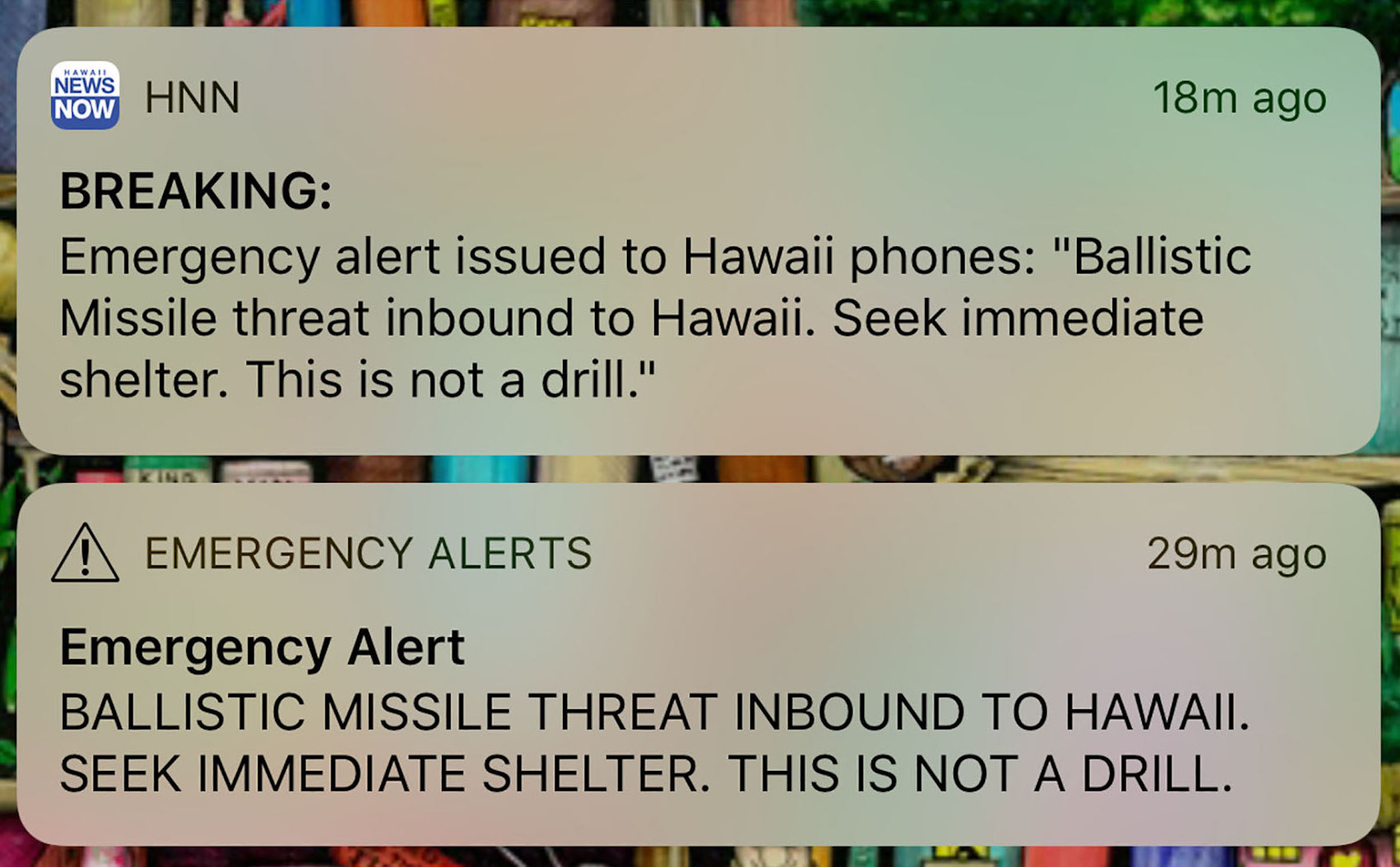
In 2018 the citizens of Hawaii were warned that a ballistic missile would strike the land or sea of the island in minutes. Everybody was told to get to shelter and prepare for the worst. This was during heightened tensions between the US and North Korea. People were alerted on their smartphones, radio, television and warning sirens. The message ended with a "this is not a drill". There were real consequences - people were calling their loved ones saying goodbye and preparing for what was about to come. 38 minutes later a second alert went out stating a "false alarm".
 
https://time.com/5102630/hawaii-false-missile-alert-procedures/ 
 
What went wrong? It turned out that the false alarm was caused by "poor computer software design" and "human factors". In the published screenshot of the computer software in question you can see the options nearly next to each other. Two different options with very different meanings, but similar wording on the same page so close to each other. It's not hard to imagine an overworked employee making this mistake.

https://www.hawaiinewsnow.com/story/37271628/officials-release-image-of-hiema-screen-that-triggered-incorrect-missile-alert/

In the days following an investigation was launched, and the state's emergency management administrator ended up resigning. However, this was not the first or last time this happened. Only 3 days later Japan had a similar incident. It wasn't even the last time for Hawaii. The next year another false alarm was sent out to the island of Oahu.

On a lighter note, Volvo has designed an emergency brake system. With the use of cameras and a radar, the system can detect an obstacle in the road and when the driver hasn't reacted to it, the system applies the emergency brakes. It first displays a warning, but when that isn't enough or when there is no time, the system activates.

https://www.volvotrucks.com/en-en/news-stories/magazine-online/2017/jul/tech-focus-emergency-brake.html
 
There's cases of this system saving lives. A video exists on YouTube where a child is seen running into the road. The child appears from behind a bus in front of the Volvo truck. With no time for the driver to react, the system activates saving the child from being run into by a truck.
 
https://www.youtube.com/watch?v=vI9EIjUx20I
 
A good design can save lives. Humans are prone to make mistakes and sometimes our lives are put into the hands of the design we create. Legislators are creating stricter regulations to keep us safer and the engineers are creating technologies to do just that. A designer should know how their creation will be used and what are the possible consequences.
 
Sources:
https://en.wikipedia.org/wiki/2018_Hawaii_false_missile_alert
https://www.washingtonpost.com/news/the-switch/wp/2018/01/30/heres-what-went-wrong-with-that-hawaii-missile-alert-the-fcc-says/
https://www.hawaiinewsnow.com/story/37271628/officials-release-image-of-hiema-screen-that-triggered-incorrect-missile-alert/
https://time.com/5102630/hawaii-false-missile-alert-procedures/
https://www.volvotrucks.com/en-en/news-stories/magazine-online/2017/jul/tech-focus-emergency-brake.html
https://www.youtube.com/watch?v=vI9EIjUx20I

Sunday, March 20, 2022

IT careers in Estonia (Week 8)

Some of us have been blessed to live in a country as digital, modern and advanced as Estonia. From e-voting to online public services, Estonia has been looked up to for years in this field, as other countries are actively trying to digitize their government nowadays as well.


But this hasn’t happened overnight. For example, in 2007, only 52% of households had an internet connection in Estonia, whereas in 2021, almost 92% homes had a stable connection. Also, our government has kept investing in the future. The annual state budget of 2021 had four different priorities and one of them focused on continuing investments for the future, especially in the digital area.


Source: https://taltech.ee/en/news/small-nations-ict-sector-intends-grow-tenfold-next-ten-years


This change has had an effect in the job market as well. Who would have thought at the start of the millennium that in twenty years we would be missing more that 40 000 workers just in the IT sector? Or that the employment growth will be enormously bigger than in other fields?

The development of IT has reflected in the workplace as well. About 20 years ago the field in Estonia was still developing, we lacked high-level experts, senior executives and quality programmers. We had way less opportunities for education and much of the labor was done by young enthusiasts, who had learned their skill themselves, instead of getting a degree in a university. Offices were older, with cheaper equipment and there weren’t any companies from Estonia making an impact on the world as we can see today.

Nowadays, being a qualified IT worker has a totally different sound to it. A high salary, benefits, freedom and a big knowledge base are automatically associated with you by others. Our workforce has diverse personnel, thanks to joining the European Union and multicultural hiring processes with remote work abilities. Many of the companies offer generous benefits packages, a very competent salary and growth opportunities while working. We have (but still not the needed amount) Estonian executives that have multiple degrees from here or abroad, skilled workers and highly-skilled programmers. Our offices are located in fancy buildings, filled with state of the art equipment and startups are actively being supported by foreign investments. Bolt and Transfer-Wise are some of the success stories that started with an idea and developed to worldwide phenomenons thanks to the support offered by our government and education, which has spread to major cities and has been integrated to primary- and high school education for younger pupils.

Surely, Estonia will still continue improvements in the area and hold the position of the most digitized government in the future. It’s just amazing to see what kind of change we have been through thanks to the efforts of everyone associated in the field. I hope that we can continue to help other states to reach such a level of competency as well.


Sources:

https://www.dw.com/en/e-government-estonia-leading-the-way/av-19119146
https://www.stat.ee/en/find-statistics/statistics-theme/technology-innovation-and-rd/information-and-communication
https://www.rahandusministeerium.ee/et/eesmargidtegevused/riigieelarve-ja-majandus/riigieelarve-ja-majandusulevaated
https://epl.delfi.ee/artikkel/94659915/liina-laas-it-spetsialistide-puudus-on-viinud-meie-majanduse-eduloo-noaterale
https://taltech.ee/en/news/small-nations-ict-sector-intends-grow-tenfold-next-ten-years

Sunday, March 6, 2022

How does Copyleft influence one's software choices? (Week 6)

Since the beginning of software development, we have seen the need for making sure that the software, programs, code and so on get sold, bought and distributed according to rules set by the owner(s). That’s where copyright came into play, allowing authors to protect their work from unauthorized copying or selling by third parties.

But what’s the case with open-source software? Is it under a copyright license, limiting everything that we know open-source for, or is it just uploaded code that anyone can do anything they please with? The answer lies in Copyleft, which is a great incentive for people to improve innovations.


In simple words, Copyleft is essentially copyright with different terms. It allows people to freely change and spread newer copies of a work without any legal issues. Most likely, it has the need to keep the state of the rights - meaning that when a free (as in freedom, not in monetary value) Copyleft-work was used to create a new project, the new project shall remain free to everyone as well.

But to be more specific, Copyleft licenses have three different grades:

No Copyleft - this type of license does not restrict any of the licensing on further copies/versions. It allows the developers to pretty much do anything with the work, but doesn’t give the end users any peace of mind that the further work will remain free and open-source.

A great example for this would be the BSD license, which imposes very minimal restrictions on the distribution of software. 

Weak Copyleft - this means that the further derived versions might not have the license, as it depends on how it was derived. This is the method used with software libraries, as the software can be linked with the library and further distributed without the new software needing a license. Some part of the code may remain closed-source or be released under a different license.

An example of weak Copyleft would be The Mozilla Public License (MPL), which can be described as a hybrid of the modified BSD license and the GPL license. It later got ruled as GPL-incompatible, and was relicensed. They are still using it for the Firefox web support.


Strong Copyleft - this is the Copyleft license that creates the need for developers to make their program fully available when redistributed to the public. That includes any components or libraries that might have been used.

The most popular example is definitely the GNU General Public License (GPL) that guarantees end users the ability to study, share, run and modify the software under this license. Their third version was released in 2007 with the final version of the license text. Many popular works use this license, like the Linux kernel, Git, Wordpress, MySQL and Notepad++.


Monday, February 28, 2022

Copyright legislation reform (Week 5)

Copyright law has been around since the invention of printing in the 15th century. Since then it has gone through many changes and iterations, however it hasn't completely adapted to the Digital Revolution of the last couple of decades. "The Case for Copyright Reform" by Rick Falkvinge and Christian Engström has some proposed changes to address this.

First of all they would like to keep the recognition of authors untouched. An author of a work should be recognized as such. This isn't a controversial statement and I agree with it. Secondly a change to non-commercial sharing of copyrighted materials is proposed. They say that only commercial sharing should be regulated. I wouldn't agree with this point if they hadn't made another point about privacy earlier. Namely you wouldn't be able to determine if something being shared was protected by copyright without spying on the conversations of users. Therefore, you couldn't enforce this and keep the privacy of the users.

Next, the time that copyright is in use for a given media should be shortened from the life of the author plus 70 years to 20 years after publication. Clearly another good proposition since currently, by the time the copyright expires for an author's works, that author is probably forgotten by most people. How many authors can you remember that have passed over 70 years ago? How many works of them can you name and how much is the public and investors interested in them. This change has to be made.

An improved system for finding authors of any works is proposed. Since it's common for works not to have authors connected to them, making finding authors sometimes impossible. This would give new life to works that otherwise couldn't be used, thus making this another excellent proposition that I agree with.

I can't really relate to the point about sampling. The authors say that sampling, remixing or in other ways reusing a work should be completely allowed. I would say that it is better to be original than to reuse material, I understand that sampling has a place. However it is the authors' opinions that it should be completely allowed without asking for permission. I believe that with the new system for discovering authors that was proposed you can easily discover any given author and ask for permission that way.

Finally a ban on DRM is proposed. I wholeheartedly agree with this one. DRM has only hurt legitimate users by ruining their experience. Usually an illegitimate copy of a work with DRM removed can give a better experience than something legitimate. DRM is a terrible technology that only gives headaches to end users and should be banned as the authors state.


Sources:

http://falkvinge.net/wp-content/uploads/large/The%20Case%20For%20Copyright%20Reform%20(2012)%20Engstrom-Falkvinge.pdf

https://en.wikipedia.org/wiki/Copyright

https://en.wikipedia.org/wiki/Digital_Revolution

Monday, February 14, 2022

Skype's influence on instant messaging and conference calls (Week 3)

In 2003 two men from a Swedish telecom company Tele2 named Niklas Zennström and Janus Friis created Skype. With the help from three Estonian men the software for Skype was developed. These three men Jaan Tallinn, Ahti Heinla and Priit Kasesalu had previously created the first ever computer game that was sold by Estonians. Zennström, Friis and Tallinn had also worked on an early (now discontinued) peer-to-peer file sharing service called Kazaa.


Download Skype: https://www.skype.com


These men partnered up and in the August of 2003 the first public version of Skype was released. Skype is a service that allows for instant messaging, voice and video calls, file transfer and even calls over landline networks. It was revolutionary in that it reduced the cost of voice calls because it used a peer-to-peer protocol for which, Friis and Annus are credited for.

In 2005 Skype was acquired by eBay for 2.5 billion dollars. In 2011 it was acquired by Microsoft after which it was integrated into many Microsoft products including the Windows Store for desktop and mobile apps. Microsoft even discontinued their own Windows Live Messenger and replaced it with Skype. Today Skype is available on almost any platform such as iOS, Linux, macOS, Android and even the Xbox.

Skype's traffic continued to grow, reaching 40% of all international calls made with Skype in 2014. However, a security flaw was discovered in Skype in 2010. Anyone could get your IP address from Skype. Because of the peer-to-peer technology used in Skype you were directly connecting to other users which meant that their IP address was revealed. It took them 6 years to finally fix this issue.

During the 2020 coronavirus outbreak people were forced to work and learn from home, which drove users to video conferencing services such as Skype. Skype saw a massive increase in its user count, about 70%. But there was a better option. In 2021, Zoom became the most used video call service worldwide and with that Skype lost about 25% of its users.

Today, Skype isn't the preferred choice for personal use for a lot of people. Services like Discord and Zoom have taken over for many reasons such as privacy or massive calls with dozens of people. But Skype still has its uses. It is still built in to Windows making it convenient to use. A lot of businesses still choose Skype over anything else and you can make calls over landline which is a unique feature.


Sources:

https://www.skype.com

https://arstechnica.com/information-technology/2018/09/skypes-secrets/

https://en.wikipedia.org/wiki/Kazaa

https://en.wikipedia.org/wiki/Skype

https://www.wsj.com/articles/BL-CIOB-286

https://www.cnet.com/news/microsofts-skype-sees-massive-increase-in-usage-as-coronavirus-spreads/

https://www.pcmag.com/news/zooms-success-during-the-pandemic-came-at-skypes-expense

Sunday, February 6, 2022

Two different technologies with different outcomes (Week 2)

The typewriter

A typewriter is a mechanical machine that is used for writing by pressing keys instead of using a pen. It features a key for every letter, number and some symbols. When a key is pressed a hand is pushed against an inked ribbon, which hits the paper, creating a character. The hands have the characters physically on them which makes them act like a stamp.

Typewriters have been around from at least the 1700s when a patent was filed in England. A typewriter was much faster than writing by hand, also blind people could use them. There was a specific typewriter made for writing music and other ones have been created for other specific uses.


https://www.engadget.com/2014-10-17-dico-typewriter-messaging.html


Eventually, the typewriter evolved into the modern keyboard. Also the QWERTY layout that is widely used today, was first used on a typewriter. Today people have a hobby of restoring these machines. You can buy new ink ribbons and replacement parts for your typewriter. You can even buy brand new and modern typewriters. Even though they are not as widely used anymore they are still around.


The laptop

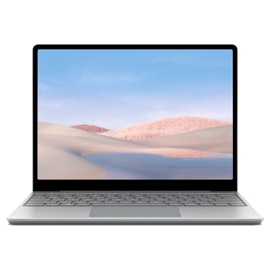
It wasn't very long after personal computers were becoming more widespread that the idea of a portable computer came about. The first idea of the laptop was in the 1970s. In about 25 years computers went from filling an entire room to fitting on your lap. Though, at first they weren't very portable. They were pretty big, some upwards of 10kg, and barely even fit on your lap. Today some can even fit in your pocket.

As with every new technology, the first laptops weren't very affordable either. A Grid Compass 1100, released in 1982 cost $8000. Laptops continued to evolve in the following decades, becoming smaller and more powerful. The Apple Powerbook was the first ever laptop to come with a touchpad (instead of a trackball) that we are used to today.

https://www.microsoft.com/en-us/d/surface-laptop-go/94fc0bdgq7wv?rtc=1&activetab=pivot:overviewtab


Laptops are still very much around today, replacing a regular PC tower for some. They're also more affordable with some costing as little as $100. You might even be provided one for school or work. They can do everything a normal-size computer can do. Battery technology has also evolved so they don't have to be plugged in during use.


Sources:

https://www.engadget.com/2014-10-17-dico-typewriter-messaging.html

https://en.wikipedia.org/wiki/Typewriter

https://www.officemuseum.com/typewriters.htm


https://steemit.com/history/@rahmat6457/history-and-development-of-laptop-from-the-time-to-the-time-7929ee28f4c3a

https://en.wikipedia.org/wiki/Laptop

https://www.microsoft.com/en-us/d/surface-laptop-go/94fc0bdgq7wv?rtc=1&activetab=pivot:overviewtab

https://en.wikipedia.org/wiki/History_of_laptops

Monday, January 31, 2022

Interesting IT solutions (Week 1)


Juku E5101 (1980s)

The Juku E5101 was a personal computer made in Estonia in the late 80s and 90s. It featured a Russian clone of the Intel i8080A processor, and an 8 bit microprocessor running at 2MHz. They were used in several schools in Estonia. It had 64 kB of RAM, a floppy drive and a tape reader for memory. It had a very bulky keyboard and mouse combination, as well as a monochrome monitor with a resolution of 320 by 240 pixels or 384 by 200 pixels. They were produced in a Narva based factory "Baltijets" and later in a factory called "Estron".

Arvutimuuseum: https://arvutimuuseum.ee/computers/list.shtml?n000


Raspberry Pi (2010s)

Raspberry Pi is a line of small computers. There are multiple models with different features and hardware. Raspberry Pi Foundation, the non-profit company that creates these computers was founded in 2009. The first model of Raspberry Pi was launched in 2012. The most recent model Raspberry Pi Zero 2 W was released in October of 2021. These single board computers are more powerful than a microcontroller like an Arduino, but less powerful than a full size computer. However a microcontroller model does exist (Raspberry Pi Pico). 

Raspberry Pi Zero 2 W: https://www.raspberrypi.com/products/raspberry-pi-zero-2-w/

The most powerful model Raspberry Pi 4, released in 2019, has a quad core processor, up to 8GB of memory as well as onboard Bluetooth, WiFi, an Ethernet port and 4 full size USB ports. It supports running 2 4K monitors at a time and was built as a replacement for a desktop computer. These computers are cheap, accessible and meant to teach programming to young people. The name Raspberry came from a tradition of giving a computer the name of a fruit, for example Apple, and Pi came from the programming language Python. Apart from the microcontroller, the cheapest model is the Raspberry Pi Zero, which costs only $5, but that is without any peripherals, like an micro SD card which is used as storage for all the models.


UltraHLE (1990s)

When the Nintendo 64 released in 1996 people thought that emulating the system on a consumer PC wouldn't be possible. On forums and chatrooms people were spreading fake emulators that turned out to just be viruses. But in 1999 two developers had taken a different approach to developing an emulator and in just 3 months created UltraHLE. Instead of trying to emulate every single instruction as accurately as possible, they had mapped specific instructions like drawing a graphic to existing ones on a Pentium II computer. This was known as high-level emulation (HLE) instead of low-level emulation (LLE).

UltraHLE: https://www.christopherbonhage.com/software/2017/05/31/flappy-bird-nintendo-64-part-1.html

This was very impressive for the time because it could run games like Super Mario 64 and Starfox 64 on resolutions bigger than the Nintendo 64 itself could. However there was a major flaw. Mapping instructions differed from game to game. UltraHLE could only play about 20 games in total.


Sources:

Juku E5101

  • https://arvutimuuseum.ut.ee/index.php?m=eksponaadid&id=165
  • https://arvutimuuseum.ee/computers/list.shtml?n000
  • https://et.wikipedia.org/wiki/Juku_(arvuti)
  • http://kalev35.planet.ee/ajaleht%20Maaleht/Maaleht%20nr%2021,%2024.%20mai%201990.pdf
Raspberry Pi
  • https://forums.raspberrypi.com/viewtopic.php?f=2&t=2657
  • https://www.raspberrypi.com
  • https://en.wikipedia.org/wiki/Raspberry_Pi
UltraHLE
  • https://www.christopherbonhage.com/software/2017/05/31/flappy-bird-nintendo-64-part-1.html
  • https://www.youtube.com/watch?v=2NF5sU_n0uk
  • https://www.emulator-zone.com/doc.php/n64/ultrahle.html

Stephen Hawkings success as a disabled scientist (Week 14)

Stephen Hawking was an Englishman born in 1942. He was a great physicist, scientist and author among other professions. He graduated from th...