Monday, February 28, 2022

Copyright legislation reform (Week 5)

Copyright law has been around since the invention of printing in the 15th century. Since then it has gone through many changes and iterations, however it hasn't completely adapted to the Digital Revolution of the last couple of decades. "The Case for Copyright Reform" by Rick Falkvinge and Christian Engström has some proposed changes to address this.

First of all they would like to keep the recognition of authors untouched. An author of a work should be recognized as such. This isn't a controversial statement and I agree with it. Secondly a change to non-commercial sharing of copyrighted materials is proposed. They say that only commercial sharing should be regulated. I wouldn't agree with this point if they hadn't made another point about privacy earlier. Namely you wouldn't be able to determine if something being shared was protected by copyright without spying on the conversations of users. Therefore, you couldn't enforce this and keep the privacy of the users.

Next, the time that copyright is in use for a given media should be shortened from the life of the author plus 70 years to 20 years after publication. Clearly another good proposition since currently, by the time the copyright expires for an author's works, that author is probably forgotten by most people. How many authors can you remember that have passed over 70 years ago? How many works of them can you name and how much is the public and investors interested in them. This change has to be made.

An improved system for finding authors of any works is proposed. Since it's common for works not to have authors connected to them, making finding authors sometimes impossible. This would give new life to works that otherwise couldn't be used, thus making this another excellent proposition that I agree with.

I can't really relate to the point about sampling. The authors say that sampling, remixing or in other ways reusing a work should be completely allowed. I would say that it is better to be original than to reuse material, I understand that sampling has a place. However it is the authors' opinions that it should be completely allowed without asking for permission. I believe that with the new system for discovering authors that was proposed you can easily discover any given author and ask for permission that way.

Finally a ban on DRM is proposed. I wholeheartedly agree with this one. DRM has only hurt legitimate users by ruining their experience. Usually an illegitimate copy of a work with DRM removed can give a better experience than something legitimate. DRM is a terrible technology that only gives headaches to end users and should be banned as the authors state.


Sources:

http://falkvinge.net/wp-content/uploads/large/The%20Case%20For%20Copyright%20Reform%20(2012)%20Engstrom-Falkvinge.pdf

https://en.wikipedia.org/wiki/Copyright

https://en.wikipedia.org/wiki/Digital_Revolution

Monday, February 14, 2022

Skype's influence on instant messaging and conference calls (Week 3)

In 2003 two men from a Swedish telecom company Tele2 named Niklas Zennström and Janus Friis created Skype. With the help from three Estonian men the software for Skype was developed. These three men Jaan Tallinn, Ahti Heinla and Priit Kasesalu had previously created the first ever computer game that was sold by Estonians. Zennström, Friis and Tallinn had also worked on an early (now discontinued) peer-to-peer file sharing service called Kazaa.


Download Skype: https://www.skype.com


These men partnered up and in the August of 2003 the first public version of Skype was released. Skype is a service that allows for instant messaging, voice and video calls, file transfer and even calls over landline networks. It was revolutionary in that it reduced the cost of voice calls because it used a peer-to-peer protocol for which, Friis and Annus are credited for.

In 2005 Skype was acquired by eBay for 2.5 billion dollars. In 2011 it was acquired by Microsoft after which it was integrated into many Microsoft products including the Windows Store for desktop and mobile apps. Microsoft even discontinued their own Windows Live Messenger and replaced it with Skype. Today Skype is available on almost any platform such as iOS, Linux, macOS, Android and even the Xbox.

Skype's traffic continued to grow, reaching 40% of all international calls made with Skype in 2014. However, a security flaw was discovered in Skype in 2010. Anyone could get your IP address from Skype. Because of the peer-to-peer technology used in Skype you were directly connecting to other users which meant that their IP address was revealed. It took them 6 years to finally fix this issue.

During the 2020 coronavirus outbreak people were forced to work and learn from home, which drove users to video conferencing services such as Skype. Skype saw a massive increase in its user count, about 70%. But there was a better option. In 2021, Zoom became the most used video call service worldwide and with that Skype lost about 25% of its users.

Today, Skype isn't the preferred choice for personal use for a lot of people. Services like Discord and Zoom have taken over for many reasons such as privacy or massive calls with dozens of people. But Skype still has its uses. It is still built in to Windows making it convenient to use. A lot of businesses still choose Skype over anything else and you can make calls over landline which is a unique feature.


Sources:

https://www.skype.com

https://arstechnica.com/information-technology/2018/09/skypes-secrets/

https://en.wikipedia.org/wiki/Kazaa

https://en.wikipedia.org/wiki/Skype

https://www.wsj.com/articles/BL-CIOB-286

https://www.cnet.com/news/microsofts-skype-sees-massive-increase-in-usage-as-coronavirus-spreads/

https://www.pcmag.com/news/zooms-success-during-the-pandemic-came-at-skypes-expense

Sunday, February 6, 2022

Two different technologies with different outcomes (Week 2)

The typewriter

A typewriter is a mechanical machine that is used for writing by pressing keys instead of using a pen. It features a key for every letter, number and some symbols. When a key is pressed a hand is pushed against an inked ribbon, which hits the paper, creating a character. The hands have the characters physically on them which makes them act like a stamp.

Typewriters have been around from at least the 1700s when a patent was filed in England. A typewriter was much faster than writing by hand, also blind people could use them. There was a specific typewriter made for writing music and other ones have been created for other specific uses.


https://www.engadget.com/2014-10-17-dico-typewriter-messaging.html


Eventually, the typewriter evolved into the modern keyboard. Also the QWERTY layout that is widely used today, was first used on a typewriter. Today people have a hobby of restoring these machines. You can buy new ink ribbons and replacement parts for your typewriter. You can even buy brand new and modern typewriters. Even though they are not as widely used anymore they are still around.


The laptop

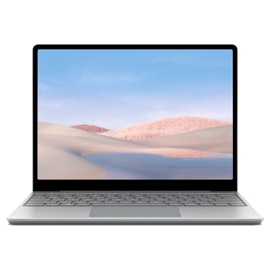
It wasn't very long after personal computers were becoming more widespread that the idea of a portable computer came about. The first idea of the laptop was in the 1970s. In about 25 years computers went from filling an entire room to fitting on your lap. Though, at first they weren't very portable. They were pretty big, some upwards of 10kg, and barely even fit on your lap. Today some can even fit in your pocket.

As with every new technology, the first laptops weren't very affordable either. A Grid Compass 1100, released in 1982 cost $8000. Laptops continued to evolve in the following decades, becoming smaller and more powerful. The Apple Powerbook was the first ever laptop to come with a touchpad (instead of a trackball) that we are used to today.

https://www.microsoft.com/en-us/d/surface-laptop-go/94fc0bdgq7wv?rtc=1&activetab=pivot:overviewtab


Laptops are still very much around today, replacing a regular PC tower for some. They're also more affordable with some costing as little as $100. You might even be provided one for school or work. They can do everything a normal-size computer can do. Battery technology has also evolved so they don't have to be plugged in during use.


Sources:

https://www.engadget.com/2014-10-17-dico-typewriter-messaging.html

https://en.wikipedia.org/wiki/Typewriter

https://www.officemuseum.com/typewriters.htm


https://steemit.com/history/@rahmat6457/history-and-development-of-laptop-from-the-time-to-the-time-7929ee28f4c3a

https://en.wikipedia.org/wiki/Laptop

https://www.microsoft.com/en-us/d/surface-laptop-go/94fc0bdgq7wv?rtc=1&activetab=pivot:overviewtab

https://en.wikipedia.org/wiki/History_of_laptops

Stephen Hawkings success as a disabled scientist (Week 14)

Stephen Hawking was an Englishman born in 1942. He was a great physicist, scientist and author among other professions. He graduated from th...